You know how every now and then, you feel like you are watching a movie of your life, rather than living it? How you look at the person you are with and thing, "Is this real, or just a dream?" Maybe I'm the only person who ever has these out-of-mind, out-of-body, life-is-surreal experiences. I'm hoping I'm not, or else I've probably confused and lost all of you by now. :)
I have had a two of those experiences over the past week. One, while spending time with Tina, my fellow mono-buddy at her lovely house in Sylva. We sat in the shade on a hillside, creeping up and back towards the forest behind us as the coolness provided by the shade receded. As we shared our memories and talked about how chronic illness had complicated our lives, I got this distinct feeling that I was there, but I also wasn't. I knew I was talking about my life, and I knew this was the Tina I lived with in North Carolina... but... it almost didn't seem like it was my life. Or that it was my Tina. Maybe it's related to that old adage, "You can never step in the same river twice." Or something very like it.
Last night, I had another one of those experiences I was sharing about at the top. I was at a Bible study group for the first time with four complete strangers. I felt like such an oddball. I haven't met truly new people in such a long time. Almost always when I meet someone, I already have some connection to them. We have a mutual friend, we go to the same school, we read the same authors, something. Here, there was next to nothing. I think part of the reason I felt that way was because I am still trying to figure out who Camille is in light of the three-year-young illness I have. It wasn't a bad or uncomfortable feeling, exactly. It just was. It was a fact. I was new. I was in control of what these people knew about me.
And yet, I chose to tell these complete strangers about my illness. As things happened, it was pretty neat. The study group wasn't actually studying anything last night; it was more of a social time, which was great for me - eating good food, and sharing our favorite books. I brought with my a copy of Polishing God's Monuments. (For my full description of the book and information on where to get your own copy, check out this older post.) After introducing my favorite author P. G. Wodehouse, I began telling them the story of Juli Andrews, whose story has a lot of parallels to my own. In college, she contracted an extremely virulent Epstein-Barr virus infection, and that was the beginning of her long battle with CFS/ME and multiple chemical sensitivities. Juli faced other problems later in her life as well, including surviving ovarian cancer. After sharing the book, I told them that my story was similar. Like Juli, I came down with EBV which just... stuck. I mentioned the term "chronic fatigue syndrome" a few times. And then, it hit. One of the girls asked, "So, what exactly is chronic fatigue syndrome?"
My mind went blank... numb. What is chronic fatigue syndrome? What is this monster that has dominated my life? What really is it? That's the million dollar question, right? Because no one really knows. No one knows where it came from or why it is so radically different from case to case. But we know one thing: It is Real. Time froze as all of the last three years have came flooding back in a wash of emotion. Chronic fatigue syndrome? It's just plain hard.
I did give a medically valid explanation, quickly stating that "chronic fatigue syndrome is NOT just being tired all the time." I paraphrased the ICC's journal article and explained how CFS is a multi-systemic neurological disorder that effects the respiratory system, the immune system, the CNS, and the mind. I explained different theories, the similarities of CFS to other more well-known illnesses like Lyme's disease and auto-immune disorders.
But I still couldn't tell them... really tell them... what it was like. They know it screwed up my life plans, but do they really know? Does anyone, other than fellow sufferers? I told them about CFS, but I didn't tell them about food allergies, candida, chronic sinus infections, insomnia. I didn't tell them about the difficulty of holding down a job, maintaining friendships, keeping up with the world and all its pain, or the high divorce and suicide rates of CFS patients... or even the more minor issues like how hard it is to get out of bed and feed yourself. I didn't tell them about brain fog, chronic pain, doctors who don't understand, the expense of treatment, or specialists. I couldn't. How could I?
Chronic fatigue syndrome... It's hard. Just plain hard.
Showing posts with label CFS/ME. Show all posts
Showing posts with label CFS/ME. Show all posts
Thursday, June 13, 2013

Saturday, March 2, 2013
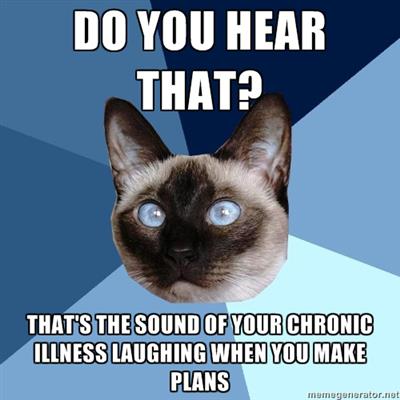
Chronic Illness Cat
I have recently made the acquaintance of the Chronic Illness Cat. I like this critter. :)
 |
| Photo Credit: Laughter is the Best Medicine |
This is so true! Every time I make plans I feel like they get changed on me!
Case in point: last time I got a job and started it in January, I had a cold within two days. What happens on Tuesday evening after my first day at work? I get a cold. Thankfully now I've discovered better ways to get over them, and it's pretty much cleared up now! :)
HT to "Lyme Disease Warrior" from Laughing at Lyme for making the formal introduction between myself and the Chronic Illness Cat ;)
Saturday, February 16, 2013
Why I Don't Believe in Miracle Cures
I still remember the surprised look on her face. "You what?"
I repeated again, "I'm on a special diet and I can't eat sugar."
"But, there is sugar in everything!" she protested.
I agreed. "Yes, which is why I'm not even able to eat fruits and have to be careful about my carbohydrate intake."
I ran into her again at the other end of the store where she asked me how long my diet was going to last.
"Six months," was my answer.
"Good luck," she wished me.
"Thanks!" I'll probably never see her again, but the conversation will stick with me for a long time.
It is difficult to pursue healing. Very difficult. It is time-consuming. It is costly.
It'd be easy if there was a miracle cure out there for Candida albicans, CFS, or cancer... but there just isn't. Progress has been made on all those fronts, but there is just no simple, easy, one-size-fits-all, just-take-this-pill answer.
And... I might shock you when I say... I don't think there ever will be.
There is a very innate, intuitive reason why we all are skeptical of "miracle cures" to our weight loss, health, and pain problems. We all realise that the human body just doesn't work that way. We realise that it takes time and effort for us to cause these problems, and that the solutions will often take longer. It is easy to accidentally cut a garment when removing a tag; it is more difficult to restore the garment to its original state of perfection. We know that the human body works the same way.
The more I learn about health and wellness, the more careful I become. The more I see and discover in my past that I thought was perfectly okay for me to eat or do which has actually caused very deep and lasting damage.
My heart breaks for the poor, exhausted mother who drains her body's precious adrenal resources by taxing this small but vital gland with the strain of numerous morning cups of coffee. My heart aches for the college student eating another cup of noodles because he doesn't understand that it isn't real food. My heart cries for those who were once thin, trim individuals who have succumbed to the toxic lure of fast food and soda, or even "healthy" yogurts, granolas, and juices which are loaded with sugar, preservatives, artificial and genetically modified ingredients.
The reason I don't believe in miracle cures is because almost everything we do stands in the way of allowing some of natures miraculous healing remedies to work. We are building road blocks when we should be clearing roads. We are holding up traffic where it ought to flow. We are ruining our lives with convenience.
And, so, when a problem arises, a process begins.
Our eyes are gradually opened. We've brought this upon ourselves. Our own choices have spelled the ruin of our health. We begin to see, for the first time. We've been tricked. And it isn't easy to take off the blinders, to foster the awareness of what the body truly needs, and to spend time in the kitchen preparing healthy food when we used to just take for granted what we could purchase at the store.
Are you willing to take the time? Are you willing to wait? Are you willing to admit you were wrong, that you were deceived, that you contributed to the state of our own downfall.
I am. Because it's the only chance I have for healing.
I can't sit around and wait for a miracle pill. But I can start rebuilding from the ground up.
Monday, February 4, 2013
Heal vs Cure
This morning I was thinking about a particular issue and wondering what the cure was for that particular situation. A cure is something almost instant. It grants sure-fire, instant results. Our society is always searching for the cure... But I think there are very few cases in which we have actually found it.
Usually what we discover on our way to searching for a cure is actually more along the lines of symptom relief. We cover up the body's pain signals and declare that the problem has been fixed.
But has it been?
In some cases, yes. Taking Valtrex and slowly killing a virus in order that it can no longer reproduce itself does--after a long time--attack and solve a long-standing problem. But in another sense, the action of taking the medication can give an impression of curing a problem while actually leaving the root unaddressed.
The fact is, there is a reason why cell reproduction skyrockets out of control and mushrooms into cancer. There is an underlying cause for autoimmune diseases where the body attacks it's own organs as invaders. There is a breakdown in the body which is indicating that perfectly normal food is not able to be processed, causing a severe reaction. There is always a reason. The question is, what is that reason? And where do we look to find it?
I really can't answer that question for everyone and all cases. But I can tell you this: there is a reason.
The fact that I know that there is a reason gives me patience on the long road to healing. If I perceived Valtrex as a cure for my chronic fatigue, I am quite sure I would be very discouraged. Because, to be honest, I still have lots of issues that haven't been solved yet. Perhaps this is solely because of the candida overgrowth in my gut, but it seems as though there must be something deeper as relates to my energy production and metabolism that is still broken.
At least I know. This realization has come after a long time and after many reminders, but now at least this truth is on the forefront of my mind.
With this knowledge, I can do battle. I can continue to search for answers and helpful therapies. I've found one in particular that seems to help, and for it I am thankful.
I urge you that if you are dealing with a chronic illness, stop searching for "the cure". More than likely, there isn't one. Some people boast of being able to cure their cancer through this or that, but there is a reason we are all skeptical when we hear such claims. (Such as, well if it was really that easy, why doesn't it work for everyone?) and the reason for our skepticism is because we intuitively know, even if we cannot articulate, that in every body, there are underlying reasons why the body is responding in the way it is.
Cancer. Depression. Chronic fatigue syndrome/myalgic encephalomyelitis. Muscle aches and pains. The common cold. AIDS.
I doubt if we'll ever find the cures. But we can look for the paths to healing. There may be more than one, but it is important to remember: there is one. If the path you're on isn't working, don't give into despair. Try a new one. Take notes of what works. And never give up. Hope may be hard to come by, but at least it never dies.*
Searching for healing,
~Nella Camille
*This last line from Joni Eareckson Tada's article in The Journal for the Christian Institute on Disability, "Hope is the Best of Things."
Usually what we discover on our way to searching for a cure is actually more along the lines of symptom relief. We cover up the body's pain signals and declare that the problem has been fixed.
But has it been?
In some cases, yes. Taking Valtrex and slowly killing a virus in order that it can no longer reproduce itself does--after a long time--attack and solve a long-standing problem. But in another sense, the action of taking the medication can give an impression of curing a problem while actually leaving the root unaddressed.
The fact is, there is a reason why cell reproduction skyrockets out of control and mushrooms into cancer. There is an underlying cause for autoimmune diseases where the body attacks it's own organs as invaders. There is a breakdown in the body which is indicating that perfectly normal food is not able to be processed, causing a severe reaction. There is always a reason. The question is, what is that reason? And where do we look to find it?
I really can't answer that question for everyone and all cases. But I can tell you this: there is a reason.
The fact that I know that there is a reason gives me patience on the long road to healing. If I perceived Valtrex as a cure for my chronic fatigue, I am quite sure I would be very discouraged. Because, to be honest, I still have lots of issues that haven't been solved yet. Perhaps this is solely because of the candida overgrowth in my gut, but it seems as though there must be something deeper as relates to my energy production and metabolism that is still broken.
At least I know. This realization has come after a long time and after many reminders, but now at least this truth is on the forefront of my mind.
With this knowledge, I can do battle. I can continue to search for answers and helpful therapies. I've found one in particular that seems to help, and for it I am thankful.
I urge you that if you are dealing with a chronic illness, stop searching for "the cure". More than likely, there isn't one. Some people boast of being able to cure their cancer through this or that, but there is a reason we are all skeptical when we hear such claims. (Such as, well if it was really that easy, why doesn't it work for everyone?) and the reason for our skepticism is because we intuitively know, even if we cannot articulate, that in every body, there are underlying reasons why the body is responding in the way it is.
Cancer. Depression. Chronic fatigue syndrome/myalgic encephalomyelitis. Muscle aches and pains. The common cold. AIDS.
I doubt if we'll ever find the cures. But we can look for the paths to healing. There may be more than one, but it is important to remember: there is one. If the path you're on isn't working, don't give into despair. Try a new one. Take notes of what works. And never give up. Hope may be hard to come by, but at least it never dies.*
Searching for healing,
~Nella Camille
*This last line from Joni Eareckson Tada's article in The Journal for the Christian Institute on Disability, "Hope is the Best of Things."
Saturday, January 26, 2013
The Most Difficult Part of Illness & The Most Glorious Part of Healing
Hi, friends and readers :)
By this time, I would most definitely place myself in the category of a recovering CFS/ME patient. It's been a long, hard road. Hopefully this is the last time that EBV says "Boo!" to me as it jumps out of the shadows. It was nice to be able to say "Boo!" to it with vitamin IVs, a vacation in Atlanta, an extended prescription of Valacyclovir (Valtrex), completely cutting gluten out of my diet, and a ton of sleep.
Now, looking back, I'm beginning to be able to pick out the superlatives of my illness. When things were worst, what was worst, what I learned most, etc. Today I want to tell you about the most difficult part of my illness. I don't think it is something unique to me, either, because someone unexpectedly mentioned this in an e-mail as a difficult part of her trial as well.
It's isolation.
Life challenges and changes are, as a general rule, separate us from those we love. Death, moving away, breaking up a relationship, choosing a new life direction, and illness are all common changes or challenges which force us into isolation and separation. In some cases, it will lead to better, deeper, more fuller new relationships, but it really depends on the people you are around in your new situation and your ability to connect with them.
And that's why one of the important parts of healing is reconnection.
Society. To me, it's an exciting word. It's big. It's noisy. It's messy. But that big, noisy mess that can bring pain and shame also has limitless possibilities for love, growth, expansion, wonderment, dreams, and new horizons.
I love to explore it. I have loved exploring it. I've loved every conversation about the inauguration, literature, philosophy, women in the military, bacteria, wellness, weight loss, and doctor's appointments. I've loved every meal, car ride, cafe, and coffee shop where friendships have been rekindled. I've reveled in the phone dates and email conversations with far away friends. I've basked in the sense of new responsibility and independence that have come with getting a new job, depositing my first pay check, making my own loan payment, and using my debit card again.
World, you are beautiful.
No longer alone,
Camille
By this time, I would most definitely place myself in the category of a recovering CFS/ME patient. It's been a long, hard road. Hopefully this is the last time that EBV says "Boo!" to me as it jumps out of the shadows. It was nice to be able to say "Boo!" to it with vitamin IVs, a vacation in Atlanta, an extended prescription of Valacyclovir (Valtrex), completely cutting gluten out of my diet, and a ton of sleep.
Now, looking back, I'm beginning to be able to pick out the superlatives of my illness. When things were worst, what was worst, what I learned most, etc. Today I want to tell you about the most difficult part of my illness. I don't think it is something unique to me, either, because someone unexpectedly mentioned this in an e-mail as a difficult part of her trial as well.
It's isolation.
Life challenges and changes are, as a general rule, separate us from those we love. Death, moving away, breaking up a relationship, choosing a new life direction, and illness are all common changes or challenges which force us into isolation and separation. In some cases, it will lead to better, deeper, more fuller new relationships, but it really depends on the people you are around in your new situation and your ability to connect with them.
And that's why one of the important parts of healing is reconnection.
Society. To me, it's an exciting word. It's big. It's noisy. It's messy. But that big, noisy mess that can bring pain and shame also has limitless possibilities for love, growth, expansion, wonderment, dreams, and new horizons.
I love to explore it. I have loved exploring it. I've loved every conversation about the inauguration, literature, philosophy, women in the military, bacteria, wellness, weight loss, and doctor's appointments. I've loved every meal, car ride, cafe, and coffee shop where friendships have been rekindled. I've reveled in the phone dates and email conversations with far away friends. I've basked in the sense of new responsibility and independence that have come with getting a new job, depositing my first pay check, making my own loan payment, and using my debit card again.
World, you are beautiful.
No longer alone,
Camille
Tuesday, November 6, 2012
Three Reasons Today is Important to Me
Today is important to me for a number of reasons.
First, it's Election Day, and I am excited to cast my first presidential ballot. I've always been a bit of a political idealist. I love reading how politics are supposed to work based on the Constitution, electoral college, checks and balances, and the view that the best leaders would naturally rise to the top, like cream on milk. The political corruption which is reality saddens my heart, but I am still thankful for the moorings provided by the Constitution and the conscience of the American people.
Second, it's another day in NaNoWriMo - another day to write a story I feel has been pent up inside of me for a long time. Already my novel is at 12,000+ words on day six of this challenge, averaging a little more than 2,000 words a day. Writing this novel, is, in a sense, part of healing for me. This is not a novel that I ever think will be made available for publication (get real; I'm writing it in a month. It's going to suck!), but the experience of writing and the themes have nonetheless become very therapeutic.
The third reason today is important to me is a very sad reason, as today marks the funeral of an ME sufferer from the UK, Emily Rose Collingridge. I hope you will take a few minutes to Google her name or read an article about her case. Emily suffered from ME from the young age of 6 all the way to her death at 30 years of age. Her symptoms were many and very extreme, including periods of blindness, paralysis, and double incontinence. But in spite of being worse than bedridden, this extraordinary young lady became an advocate for ME sufferers and even wrote a book as a guide to living with the illness that claimed her life. Hats off to Emily. Her story has motivated me to raise what awareness I can in order to help severe ME patients know that they are not alone.
What makes today special to you?
First, it's Election Day, and I am excited to cast my first presidential ballot. I've always been a bit of a political idealist. I love reading how politics are supposed to work based on the Constitution, electoral college, checks and balances, and the view that the best leaders would naturally rise to the top, like cream on milk. The political corruption which is reality saddens my heart, but I am still thankful for the moorings provided by the Constitution and the conscience of the American people.
Second, it's another day in NaNoWriMo - another day to write a story I feel has been pent up inside of me for a long time. Already my novel is at 12,000+ words on day six of this challenge, averaging a little more than 2,000 words a day. Writing this novel, is, in a sense, part of healing for me. This is not a novel that I ever think will be made available for publication (get real; I'm writing it in a month. It's going to suck!), but the experience of writing and the themes have nonetheless become very therapeutic.
The third reason today is important to me is a very sad reason, as today marks the funeral of an ME sufferer from the UK, Emily Rose Collingridge. I hope you will take a few minutes to Google her name or read an article about her case. Emily suffered from ME from the young age of 6 all the way to her death at 30 years of age. Her symptoms were many and very extreme, including periods of blindness, paralysis, and double incontinence. But in spite of being worse than bedridden, this extraordinary young lady became an advocate for ME sufferers and even wrote a book as a guide to living with the illness that claimed her life. Hats off to Emily. Her story has motivated me to raise what awareness I can in order to help severe ME patients know that they are not alone.
What makes today special to you?
Tuesday, September 18, 2012
POTS
Have you ever heard of POTS? No, not a flower pot, not a kitchen pot, or the drug pot - POTS. It stands for postural tachycardia syndrome.


Photo Credit: self-made, using www.pixlr.com.
If you remember my post in August titled, 'Recumbency' and what I described there as orthostatic intolerance, you have a tiny slice of what POTS is. It is the dizziness, the difficulty of doing anything while sitting or standing, but with a new component: rapid heartbeat.
After a number of sleep-deprived nights, I noticed my heartbeat was faster and harder than seemed healthy. I counted my pulse, and found that it was a little over 100. During the day, it only became more elevated. The highest I know it got was 120, but a few times after that it was going so fast I couldn't keep straight what I was counting. (That was partially because I was so sleep deprived....) Now, several days and a few good nights of sleep afterward, at night or in the early morning, my heartbeat will be down between 72-76. If I sit up in bed for a few minutes, it will go up by 10 bpm withing a few minutes. (I tried this last night. Lying down heart rate was 72, after sitting up it was 86.) Over the past few days I've counted my pulse several times, and it seems to range somewhere between 90-110, depending on the day.
I remember briefly reading this PDF on POTS (which I also linked to under Recumbency) so I read it again a few days ago. Before it made sense to me only so far as I identified with certain symptoms of orthostatic intolerance. Now I understand and can identify with much more, such as the blood pressure and heart rate moving in inverse directions once I stand up. It's interesting to feel the processes being described in the paper happening in my body.
This doesn't seem to be as much of a problem now that I've been sleeping better, but I know POTS is something many people with CFS struggle with and I wanted to blog at least a little bit about my experience with it.
What's you're heart beat like? :)
This doesn't seem to be as much of a problem now that I've been sleeping better, but I know POTS is something many people with CFS struggle with and I wanted to blog at least a little bit about my experience with it.
What's you're heart beat like? :)
Sunday, September 2, 2012
What is behind the unpronounceable name?
Found this photo and thought it would be helpful in explaining what myalgic encephalomyelitis is by explaining what it means.


Image Source: www.facebook.com/MEAwarenessPics
Most often I feel pain in my brain. I know that it is technically impossible to feel pain in the brain, but that's what it feels like to me, and I can't offer an actual medical explanation, but that is what it feels like. I have no doubt that many or most of my chronic headaches (the various generations of Horace) stem from inflammation of the brain and spinal cord. I also get muscle pain in my neck and back, which are usually held at bay through chiropractic treatments, icing, heating, and attempts at good posture.
Blessings on your Sunday and Labor Day tomorrow!
~Camille
Saturday, September 1, 2012
30 Things about CFS/ME

Photo credit: http://www.invisibleillnessweek.com
I'm following closely a social media campaign called Invisible Illness week, and I noticed this questionnaire on the website and thought it might be fun to fill it out. Hope you enjoy and learn a few random facts about me!
- The illness I live with is: chronic fatigue syndrome/myalgic encephalomyelitis
- I was diagnosed with it in the year: 2012
- But I had symptoms since: 2010
- The biggest adjustment I’ve had to make is: listening to my body instead of pushing it, and cutting back on my academic goals
- Most people assume: that CFS just means that I'm tired all the time, but it's much more than that
- The hardest part about mornings are: feeling like a fly stuck in molasses
- My favorite medical TV show is: hmm... my favorite TV show is Fringe, but I don't really watch medical TV
- A gadget I couldn’t live without is: my battery powered lantern. I can't use regular lights after dark, but the lantern is enough light to see by, but not enough to hurt my eyes.
- The hardest part about nights are: knowing other people are usually out in the evenings having fun with friends, but I have to go to sleep early or am too tired to socialize. Plus insomnia.
- Each day I take 28 pills & vitamins, soon to be 34.
- Regarding alternative treatments: I am open to reasonable suggestions, provided there is a significant reason why I should consider it rather than just a slim reason it maybe could help.
- If I had to choose between an invisible illness or visible I would choose: I think I would rather have a visible illness, but this might just be because the grass is always greener on the other side of the fence. Having an invisible illness is annoying because people don't really know how you are doing unless they ask, and sometimes I'm not in the mood to share, and that's hard to explain.
- Regarding working and career: it is impossible to work the kinds of jobs I have in the past, but I'm hoping that I will improve enough to start doing some things from home right now.
- People would be surprised to know: that I'm sick at all.
- The hardest thing to accept about my new reality has been: changing my plans countless times because I'm not able to work or pursue my academic goals at the rate I thought I would be able to.
- Something I never thought I could do with my illness that I did was: do a sudoku in less than 10 minutes... but I did one in 9 minutes and 4 seconds! :)
- The commercials about my illness: don't exist...? But there are a few YouTube videos you can check out, such as this one.
- Something I really miss doing since I was diagnosed is: reading extensively.
- It was really hard to have to give up: eating sugar, because I have a huge sweet tooth!
- A new hobby I have taken up since my diagnosis is: resting and sleeping.
- If I could have one day of feeling normal again I would: wake up early, take a long walk with my dad, get my drivers license, drive to Indiana, and spend the day with my best friend.
- My illness has taught me: that I am not what I do, can do, or can't do.
- Want to know a secret? One thing people say that gets under my skin is: "So, chronic fatigue syndrome. What does that mean? Are you just tired all the time?"
- But I love it when people: know when to listen, and know when to tell me about their life to distract me from what I'm going through.
- My favorite motto, scripture, quote that gets me through tough times is: heaven... where all the wrong will be right
- When someone is diagnosed I’d like to tell them: sleep now, or forever hold your peace
- Something that has surprised me about living with an illness is: how hard it is to get people to understand.
- The nicest thing someone did for me when I wasn’t feeling well was: mail me a box of gluten free, sugar free cookies and a card!
- I’m involved with Invisible Illness Week because: I want to raise awareness about CFS/ME and be encouraged by others who have different invisible illnesses.
- The fact that you read this list makes me feel: loved. Thanks :)
Wednesday, August 29, 2012
Doctor's Visit Report (8/27)
Dear Praying Friends,
Thank you so much for praying for our trip! I guess it went pretty well. I was very tired by the time we arrived in Flint (I know I used to get up at 3 every day, but now I like my sleep!) and had the beginnings of another encounter with Horace.
My two-and-a-half hour appointment began with an extensive review of my previous medical history. Thankfully most of that was already written down, so Dr. Conley read aloud to himself, asking a few questions as he went, and I just sat back and relaxed. For once, a doctor took me seriously when I told them I thought I had chronic fatigue and didn't say, "Oh, well let's try this first," or "Have you thought about this other illness or that organ having something wrong?" I really appreciated that I didn't have to prove that I had chronic fatigue; Dr. Conley could see that I do.
At the end of reading my case, Dr. Conley said, "Pretty straightforward!" and then muttered, "knock on wood" as he rapped twice on his desk. He began to assure me that I would get better - that he knew how to treat what was going on, and that there were many things that could be done to help me. I was glad. He gave us hope. Since I have been on before and responded so well to Valtrex, an antiviral drug which helps suppress the EBV, he ordered a prescription for that. A second positive response to Valtrex will not only help my body get back on its feet, but will also help 'buy time' while we wait on the results of some other tests to see what they reveal about the functionality of my body, even down to a cellular level. He put me on a few other prescriptions/supplements (potassium, calcium, lysine) and ordered a bunch of bloodwork and a few other lab kits.
Then he began flipping past the actual story of my illness, reviewed the family medical history, and then started looking more deeply at some of my symptoms. I made sure that I had recorded incidents of 'paralysis' such as this one and told him about others. At this point, he became very serious. So the new name for my episodes of what-seems-like-paralysis-but-is-not is 'spasms.' For these, Dr. Conley thinks I should see a neurologist. Since he's the third doc who has said this, I think this time we might actually make an appointment and go through with it. Please be in prayer for me as I try to find one today; one that accepts our insurance would be grand.
By the time the appointment was over and we were driving south the the Detroit area to stay with friends I had to cover my eyes with a sweater because my sensitivities to light had sky rocketed. By 9 o'clock I was sound asleep, and I slept for 12 hours and yet still woke up with ugly Horace there. God provided in a funny way for something to help Horace behave himself yesterday during our drive back. Our host heard about my sensitivities to light and found an old pair of welding glasses he wasn't using anymore. Surprisingly, they fit over my glasses. They turn the world so green you would think you were in the Emerald City, and they weren't the prettiest things in the world, but, hey! they kept my headache from getting any worse and I wasn't stuck underneath a sweater the whole way home!
Good news: my follow-up appointment in one month will be over the phone, so no long drive to Flint next month!
If you have any further questions about the appointment or the details of what the doc said, feel free to comment or shoot me an e-mail.
Blessings,
~Camille
Thank you so much for praying for our trip! I guess it went pretty well. I was very tired by the time we arrived in Flint (I know I used to get up at 3 every day, but now I like my sleep!) and had the beginnings of another encounter with Horace.
My two-and-a-half hour appointment began with an extensive review of my previous medical history. Thankfully most of that was already written down, so Dr. Conley read aloud to himself, asking a few questions as he went, and I just sat back and relaxed. For once, a doctor took me seriously when I told them I thought I had chronic fatigue and didn't say, "Oh, well let's try this first," or "Have you thought about this other illness or that organ having something wrong?" I really appreciated that I didn't have to prove that I had chronic fatigue; Dr. Conley could see that I do.
At the end of reading my case, Dr. Conley said, "Pretty straightforward!" and then muttered, "knock on wood" as he rapped twice on his desk. He began to assure me that I would get better - that he knew how to treat what was going on, and that there were many things that could be done to help me. I was glad. He gave us hope. Since I have been on before and responded so well to Valtrex, an antiviral drug which helps suppress the EBV, he ordered a prescription for that. A second positive response to Valtrex will not only help my body get back on its feet, but will also help 'buy time' while we wait on the results of some other tests to see what they reveal about the functionality of my body, even down to a cellular level. He put me on a few other prescriptions/supplements (potassium, calcium, lysine) and ordered a bunch of bloodwork and a few other lab kits.
Then he began flipping past the actual story of my illness, reviewed the family medical history, and then started looking more deeply at some of my symptoms. I made sure that I had recorded incidents of 'paralysis' such as this one and told him about others. At this point, he became very serious. So the new name for my episodes of what-seems-like-paralysis-but-is-not is 'spasms.' For these, Dr. Conley thinks I should see a neurologist. Since he's the third doc who has said this, I think this time we might actually make an appointment and go through with it. Please be in prayer for me as I try to find one today; one that accepts our insurance would be grand.
By the time the appointment was over and we were driving south the the Detroit area to stay with friends I had to cover my eyes with a sweater because my sensitivities to light had sky rocketed. By 9 o'clock I was sound asleep, and I slept for 12 hours and yet still woke up with ugly Horace there. God provided in a funny way for something to help Horace behave himself yesterday during our drive back. Our host heard about my sensitivities to light and found an old pair of welding glasses he wasn't using anymore. Surprisingly, they fit over my glasses. They turn the world so green you would think you were in the Emerald City, and they weren't the prettiest things in the world, but, hey! they kept my headache from getting any worse and I wasn't stuck underneath a sweater the whole way home!
Good news: my follow-up appointment in one month will be over the phone, so no long drive to Flint next month!
If you have any further questions about the appointment or the details of what the doc said, feel free to comment or shoot me an e-mail.
Blessings,
~Camille
Sunday, August 19, 2012
Recumbency
I wrote in part 4 of an explanation of ME about one of my symptoms called orthostatic intolerance (OI). In layman's terms, OI basically means I have a difficult time doing anything while standing up, or if I do stand up and do something, I'm likely to get more tired while standing up than if I were to remain seated (in a certain posture) or reclining. If I stand up for too long, I get very dizzy. My ears might ring, or noise that is close by will sound distant. My blood pressure drops (and it usually runs low anyway). My vision will blur, or I will be unable to focus with my eyes. If I am really pushing it, I will begin to feel as though I will pass out at any moment. It's been difficult for me to do routine things, such as wash laundry, exercise, take care of a bit of routine cleaning, read, and even Skype with friends.
To say that it is difficult go through life with a condition like orthostatic intolerance is an understatement. But as this symptom and its effect have worsened, I truly am forced to rely more on God's grace and strength. What vestiges of my independent life I had I have had to surrender to Him this week as I've spent more days and more hours in bed than out.
OI reminds me of a word I haven't thought of in a while: recumbency. For those of you who have been around at Garden Heights for several years and knew Bill Davis, you may remember that this was one of his favorite words. Recumbency means to recline, rely, or trust, and is a Puritan word used to describe faith as resting in God. You might not have heard of recumbency, but you've probably heard of a recumbent bike. The idea is the same: recline, or rest. OI is providing me with a unique opportunity to rest in God--physically, and spiritually, when I am tempted to be anxious. God has already provided my atonement and redemption; I trust Him to meet my physical needs as well. The words of a song, "You'll Provide for Me," sum up my thoughts right now.
Leaning, reclining, in the state of deepest repose,
~Camille
(Yesterday morning I read an extensive PDF explaining two common types of OI (POTS and NMH). If you are interested in reading it, I commend it to you - but recommend that you have a good chunk of time on your hands. The entire document is 27 pages long. I must confess I only read the first 8 pages and then skimmed the rest.)
To say that it is difficult go through life with a condition like orthostatic intolerance is an understatement. But as this symptom and its effect have worsened, I truly am forced to rely more on God's grace and strength. What vestiges of my independent life I had I have had to surrender to Him this week as I've spent more days and more hours in bed than out.
OI reminds me of a word I haven't thought of in a while: recumbency. For those of you who have been around at Garden Heights for several years and knew Bill Davis, you may remember that this was one of his favorite words. Recumbency means to recline, rely, or trust, and is a Puritan word used to describe faith as resting in God. You might not have heard of recumbency, but you've probably heard of a recumbent bike. The idea is the same: recline, or rest. OI is providing me with a unique opportunity to rest in God--physically, and spiritually, when I am tempted to be anxious. God has already provided my atonement and redemption; I trust Him to meet my physical needs as well. The words of a song, "You'll Provide for Me," sum up my thoughts right now.
I will rest in Your sovereign plan
And bless Your gracious hand;
I know Your promise stands
That I'll see Your goodness in this land.
Leaning, reclining, in the state of deepest repose,
~Camille
(Yesterday morning I read an extensive PDF explaining two common types of OI (POTS and NMH). If you are interested in reading it, I commend it to you - but recommend that you have a good chunk of time on your hands. The entire document is 27 pages long. I must confess I only read the first 8 pages and then skimmed the rest.)
Thursday, July 19, 2012
An Explanation of Myalgic Encephalomyelitis (Part 4)
4.) Energy production/transportation impairments.
If I was light in the symptoms of the previous group, I am not so fortunate in this group. I had fun reading this section of the journal article, though, because it helped me understand and identify some of the symptoms I had been experiencing but didn't know how to explain. The biggest one like this is called orthostatic intolerance, which is basically the inability to tolerate an upright position. This is one reason why church attendance is so difficult for me, especially in the morning. Some of you who attend church with me know that I used to sit on the floor during Sunday School. The only way I could explain it was that it was less work for me to try to support my entire chest and that sitting on the floor in the corner I was more fully supported and used less energy. Now I know why - orthostatic intolerance! Lighteheadedness or dizziness can follow if I do not sit down quickly enough, or if I am fatigued and sitting down, signalling that my body can no longer even sit and I must lie down.
Particularly bothersome the past two weeks or so have been a respiratory difficulty which has caused me a great deal of difficulty breathing. At first I assumed that my sinuses were clogged. But when nasal massages, hot showers, and steam inhalation failed to shake anything loose, I quickly realised that I was not having difficulty breathing because of my sinuses being clogged, but simply because I was so tired I could hardly breathe. This has improved somewhat with rest, but remains an issue. Thankfully, a good friend reminded me that breathing was an automatic bodily function like a heartbeat or blinking, so I didn't have to worry that I would stop breathing while I was sleeping. (Although, I must admit, I almost said to her, "What are you talking about? Breathing is work!")
Another symptom of both the adrenal fatigue and the ME is "loss of thermostatic stability," or a constantly fluctuating temperature. My temperature consistently runs low (the most consistent reading I've gotten is 97.3 degrees Farenheit), but I often feel feverish especially during the evening or night. Please note that this is not due to summer heat. In fact, this symptom was worse during the early spring months. I thought for several nights in a row that I had a fever so I bought a thermometer so that I could track my temperature. However, despite feeling feverish, my temperature was very low - sometimes as low as 96.2 - despite feeling hot and sweating. One symptom which has 'improved' due to summer heat is cold extremities. My feet and fingers positively feel like ice blocks in the winter! But they have finally thawed! Either way, summer or winter, I have a difficult time with extreme temperatures on either end. I know we all prefer a nice even 70 all year long, but I do especially. Sometimes climate control makes this easier, but other times very strong air conditioning can make me feel just as poorly as a hot, humid afternoon.
If you have read this far, thank you! You are a good listener and a patient friend.
If I was light in the symptoms of the previous group, I am not so fortunate in this group. I had fun reading this section of the journal article, though, because it helped me understand and identify some of the symptoms I had been experiencing but didn't know how to explain. The biggest one like this is called orthostatic intolerance, which is basically the inability to tolerate an upright position. This is one reason why church attendance is so difficult for me, especially in the morning. Some of you who attend church with me know that I used to sit on the floor during Sunday School. The only way I could explain it was that it was less work for me to try to support my entire chest and that sitting on the floor in the corner I was more fully supported and used less energy. Now I know why - orthostatic intolerance! Lighteheadedness or dizziness can follow if I do not sit down quickly enough, or if I am fatigued and sitting down, signalling that my body can no longer even sit and I must lie down.
Particularly bothersome the past two weeks or so have been a respiratory difficulty which has caused me a great deal of difficulty breathing. At first I assumed that my sinuses were clogged. But when nasal massages, hot showers, and steam inhalation failed to shake anything loose, I quickly realised that I was not having difficulty breathing because of my sinuses being clogged, but simply because I was so tired I could hardly breathe. This has improved somewhat with rest, but remains an issue. Thankfully, a good friend reminded me that breathing was an automatic bodily function like a heartbeat or blinking, so I didn't have to worry that I would stop breathing while I was sleeping. (Although, I must admit, I almost said to her, "What are you talking about? Breathing is work!")
Another symptom of both the adrenal fatigue and the ME is "loss of thermostatic stability," or a constantly fluctuating temperature. My temperature consistently runs low (the most consistent reading I've gotten is 97.3 degrees Farenheit), but I often feel feverish especially during the evening or night. Please note that this is not due to summer heat. In fact, this symptom was worse during the early spring months. I thought for several nights in a row that I had a fever so I bought a thermometer so that I could track my temperature. However, despite feeling feverish, my temperature was very low - sometimes as low as 96.2 - despite feeling hot and sweating. One symptom which has 'improved' due to summer heat is cold extremities. My feet and fingers positively feel like ice blocks in the winter! But they have finally thawed! Either way, summer or winter, I have a difficult time with extreme temperatures on either end. I know we all prefer a nice even 70 all year long, but I do especially. Sometimes climate control makes this easier, but other times very strong air conditioning can make me feel just as poorly as a hot, humid afternoon.
If you have read this far, thank you! You are a good listener and a patient friend.
Monday, July 16, 2012
An Explanation of Myalgic Encephalomyelitis (Part 3)
3.) Immune, gastro-intestinal and genitourinary impairments.
Of all the symptoms categories, this is by far my lightest group, but I still meet the diagnostic criteria. Some with ME suffer from chronic or recurring flu-like symptoms including sore throat, inflammation of the sinuses, and enlarged or tender lymph nodes. My main symptom, which used to be more pronounced but is improving due to dietary changes and supplements, is nausea. In January and February, I was nauseous almost constantly, after every meal. Sensitivities to food, smells, and chemicals (this is a big culprit) is another symptom that I have from this category. The main reaction to chemicals (either using them or even smelling them) is headaches and a burning feeling behind my eyes, but it can also trigger nausea. For this reason, I only use baking soda for cleaning and am looking into some natural toilet bowl cleaners and multipurpose cleaners to purchase. I have also stopped wearing any kind of body spray, and try to avoid people wearing strong perfumes (no offense) or lots of hair spray. Please let me say at this point, these reactions might sound bad to you; I mean, everyone has to clean, right? and every girl loves body spray! But the reactions I have to chemicals are nothing like what some ME patients experience who also suffer from something called multiple chemical sensitivities (MCS). If you are interested in reading a living biography of a young woman who has ME and MCS, I invite you to check out Polishing God's Monuments, written by her father, Pastor Jim Andrews. My dad and I both read this book several years ago before I even had mono, and Juli's story has been a beacon of encouragement to me during the course of my illness. Oh, and the genitourinary impairments? Not sure why this is a symptom of ME, but for some reason, we ME-ers feel the need to pee frequently, and this urge in the wee hours of the morning also doesn't help the insomnia bit I talked about previously.
The next post in this series will complete my explanation of the journal article.
Saturday, July 14, 2012
An Explanation of Myalgic Encephalomyelitis (Part 2)
2.) Neurological impairments.
My worst symptom in this category is difficulty processing information. It is frustrating and embarrassing to be confused, disoriented, mentally overloaded, and speaking slowly when a person is trying to have a conversation with me and my brain is trying to catch up and focus on where the floor is and how quickly I can sit down if I need to - or worse, trying to plan how I can excuse myself from a conversation as quickly as possible and escape. I have also been dealing with what I can only explain as an acquired but different case of dyslexia. This problem occasionally bother me when I'm reading, but mainly poses a problem from an auditory standpoint. As an example, my mom was talking about the recent Supreme Court decision which stated that the healthcare package would be considered a tax. Over and over again, I was convinced she was saying that the healthcare package would be considered attacks. In frustration, I said, "What do you mean, attacks?" Since a tax and attacks sound the same, the confusion took a while to clear up. If this does happen when I am reading, I stare blankly at the page for several minutes, wondering why someone is talking about someone winding a clock when he is obviously talking about the wind that blows through the trees... only to realise that he is talking about the wind and that wind and wind share the same spelling.
I once jokingly remarked to my little brother that I have the memory of a 70 year old women. Sometimes, it's true. I always used to tease my mom about forgetting things, but now more details slip my mind than I would care to admit. My most common problem is word retrieval - or, I am realising - name retrieval. Not so much people I see on a regular basis, but people who were on my wing at school, and I'm looking at chorale tour pictures and know that I should know who that person is but cannot remember her name.
Headaches and pain have been two symptoms I have been dealing with this week a lot. Headaches and pain don't seem very uncommon, you might say, however the headaches I have had since my mono days are unlike any headaches I have ever had before. Sometimes they are chronic - lasting for days or weeks at a time (this happened last summer for I think about three weeks). Other times they feel as if they are originating directly behind my eyes, others seem to stem from the base of my neck below my brain. My chiropractor has been able to help me reduce my headaches this spring, but now they are back again.Pain is generally limited to places in my upper back between my shoulder blades, but it can also radiate downwards into my lower back. Yesterday I had gripping, long-lasting pain in my chest. Sometimes the pain is so overwhelming that all I can think is, "Pain, pain, pain," for hours as I lie in bed, unable to think or move.
And then there are the sleep disturbances. Whether its insomnia, a penchant for multi-hour naps in the afternoon hours, inability to sleep at night, frequently awakening during the night, or unrefreshing sleep and daytime sleepiness, no part of the sleep disturbances are pleasant. My biggest complaint a few months ago was the unrefreshing sleep. I would feel exhausted when I laid down, and exhausted when I woke up, despite how long I slept. Now the insomnia and daytime sleepiness have come to the forefront again. Despite being exhausted and dragging all afternoon, when it comes bedtime, I simply cannot fall asleep. It is possible that this is a result not directly of the ME, but of fatigued adrenals and an imbalance in my body's production of a hormone called cortisol. However, I have not yet had my cortisol levels tested, so this is just a speculation. Ironically, when I am most fatigued is when I have the most difficulty sleeping and awaking feeling refreshed and energetic.
Also troubling this week in particular have been extreme sensitivities to light (manmade more than sunlight) and noises. Oftentimes vibration, odor, taste, and touch also cause sensitivities. Along with these sometimes come muscle weakness (with light and noise), twitching, poor coordination (generally), and feeling of unsteadiness while on my feet. The more tired I become, the more pronounced these sensitivities become. Recently my light sensitivities have been so drastic that in the evening I can only use my computer if the screen is on the dimmest setting and all the lights are off in my room. After about 7 or 8 when it begins to become dark at night, almost all manmade lights cause pain in my eyes or exacerbate a headache.
My worst symptom in this category is difficulty processing information. It is frustrating and embarrassing to be confused, disoriented, mentally overloaded, and speaking slowly when a person is trying to have a conversation with me and my brain is trying to catch up and focus on where the floor is and how quickly I can sit down if I need to - or worse, trying to plan how I can excuse myself from a conversation as quickly as possible and escape. I have also been dealing with what I can only explain as an acquired but different case of dyslexia. This problem occasionally bother me when I'm reading, but mainly poses a problem from an auditory standpoint. As an example, my mom was talking about the recent Supreme Court decision which stated that the healthcare package would be considered a tax. Over and over again, I was convinced she was saying that the healthcare package would be considered attacks. In frustration, I said, "What do you mean, attacks?" Since a tax and attacks sound the same, the confusion took a while to clear up. If this does happen when I am reading, I stare blankly at the page for several minutes, wondering why someone is talking about someone winding a clock when he is obviously talking about the wind that blows through the trees... only to realise that he is talking about the wind and that wind and wind share the same spelling.
I once jokingly remarked to my little brother that I have the memory of a 70 year old women. Sometimes, it's true. I always used to tease my mom about forgetting things, but now more details slip my mind than I would care to admit. My most common problem is word retrieval - or, I am realising - name retrieval. Not so much people I see on a regular basis, but people who were on my wing at school, and I'm looking at chorale tour pictures and know that I should know who that person is but cannot remember her name.
Headaches and pain have been two symptoms I have been dealing with this week a lot. Headaches and pain don't seem very uncommon, you might say, however the headaches I have had since my mono days are unlike any headaches I have ever had before. Sometimes they are chronic - lasting for days or weeks at a time (this happened last summer for I think about three weeks). Other times they feel as if they are originating directly behind my eyes, others seem to stem from the base of my neck below my brain. My chiropractor has been able to help me reduce my headaches this spring, but now they are back again.Pain is generally limited to places in my upper back between my shoulder blades, but it can also radiate downwards into my lower back. Yesterday I had gripping, long-lasting pain in my chest. Sometimes the pain is so overwhelming that all I can think is, "Pain, pain, pain," for hours as I lie in bed, unable to think or move.
And then there are the sleep disturbances. Whether its insomnia, a penchant for multi-hour naps in the afternoon hours, inability to sleep at night, frequently awakening during the night, or unrefreshing sleep and daytime sleepiness, no part of the sleep disturbances are pleasant. My biggest complaint a few months ago was the unrefreshing sleep. I would feel exhausted when I laid down, and exhausted when I woke up, despite how long I slept. Now the insomnia and daytime sleepiness have come to the forefront again. Despite being exhausted and dragging all afternoon, when it comes bedtime, I simply cannot fall asleep. It is possible that this is a result not directly of the ME, but of fatigued adrenals and an imbalance in my body's production of a hormone called cortisol. However, I have not yet had my cortisol levels tested, so this is just a speculation. Ironically, when I am most fatigued is when I have the most difficulty sleeping and awaking feeling refreshed and energetic.
Also troubling this week in particular have been extreme sensitivities to light (manmade more than sunlight) and noises. Oftentimes vibration, odor, taste, and touch also cause sensitivities. Along with these sometimes come muscle weakness (with light and noise), twitching, poor coordination (generally), and feeling of unsteadiness while on my feet. The more tired I become, the more pronounced these sensitivities become. Recently my light sensitivities have been so drastic that in the evening I can only use my computer if the screen is on the dimmest setting and all the lights are off in my room. After about 7 or 8 when it begins to become dark at night, almost all manmade lights cause pain in my eyes or exacerbate a headache.
Friday, July 13, 2012
An Explanation of Myalgic Encephalomyelitis (Part 1)
Note: To be clear from the very beginning, the osteopath I have been seeing has diagnosed me with a chronic case of mono, so I have not yet been diagnosed with Myalgic Encephalomyelitis (affectionately known as my D.L.F. [Dear Little Friend, for those of you who aren't Lewis readers] ME).
What follows here is my explanation and understanding of a medical journal article which was the published research of the Internal Consensus Criteria made available in the Journal of Internal Medicine in 2011. You can find the article here online or in PDF format. The ICC has broken down the symptoms of ME into four groups. Under these groups are a number of subcategories, and so many symptoms must be present from each group or one from each subcategory in order for a patient to be diagnosed according to these criteria. If you are eager to test your understanding of medical terms, I am sure you will find the journal article more interesting. If you're not so eager to spend a few hours trying to understand a 13 page document, I hope my explanation will suffice.
ME causes dysregulation of the central nervous system, immune system, cellular metabolism, and cardiovascular system. According to the ICC, it is 'an acquired neurological disease with complex global dysfunctions' from which 50,000 people suffer. These are the symptoms.
1.) Postexertional neuroimmune exhaustion.
On my worst days, when I attempt to think deeply about something, my mental state quickly becomes a confusing fog of swirling words and concepts. The very thought of supporting my body in order to sit or eat is exhausting. Sometimes I try to force myself to do things. Such forcing my body to obey me might bring on another state of exhaustion even deeper than the first, lasting at times for a few hours.
On a day where I seem to be 'normal', I might be able to do something mildly strenuous, such as take a walk or attempt a light workout. After taking that walk or light workout, I might face a severe worsening of another symptom, such as muscle weakness, lightheartedness or dizziness, feeling feverish, or labored breathing. Often times going places, preparing a meal, reading a book, or simply sitting upright and working at my computer will also trigger these worsening of symptoms. (Just as an example, I have had a headache most of the time while writing this post and have to take frequent breaks to rest my eyes and lay down.)
On any day, whether good, bad, or in the middle, every activity completed or even attempted comes with a recovery period because my body is unable to muster the energy it needs to sustain me through daily activities. This recovery period can last twenty-four hours, a few days, or even a week. The strenuousness, chemical exposure, lighting, temperature, and activity all determine how long the recovery time might be. As a general rule, it takes me much longer to recover from time spent running errands than it does to recover from studying.
My lack of stamina varies in severity from mild, to moderate, to severe, to very severe. I would currently place myself in a moderate category, which means I am mostly housebound. Yes, I can get along fine for a few hours out running errands, studying at Starbucks, or (most difficult) a trip to church, but I am much more comfortable at home where my brain has less information to process and fewer choices to make.
Since this post in its entirety would be quite lengthy, it will be published in four parts. Stay tuned for the next update explaining the neurological impairments of ME!
Subscribe to:
Posts (Atom)